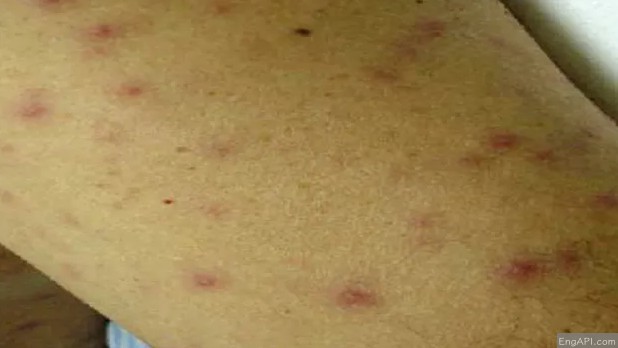
typhus
音标:
英音/ ˈtaɪfəs / 美音/ ˈtaɪfəs /
听听基本释意:
外刊例句:
Not since 1943, when the town suffered a typhus outbreak, had anything similar happened.
自 1943 年该镇爆发斑疹伤寒以来,还没有发生过类似的事情。
—The Guardian
The smell of corpses told her why she was required to get typhus and typhoid vaccinations before her arrival.
尸体的气味告诉她为什么她需要在抵达前接种斑疹伤寒和伤寒疫苗。
—Seattle Times
From the start of the European conquest, outbreaks of smallpox, bubonic plague and typhus ravaged the tribe.
从欧洲征服开始,天花、黑死病和斑疹伤寒的爆发就肆虐着这个部落。
—New York Times
基本释意:
noun
rickettsial disease transmitted by body lice and characterized by skin rash and high fever
[内科] 斑疹伤寒症
同义词:
没有找到同义词
短释义:
无
长释义:
无
文学例句:
“Maybe. Or no food. Or the cold. Or typhus. Take your pick.”
“也许吧。或者没有食物。或者感冒。或者斑疹伤寒。你选吧。”
—Milkweed by Jerry Spinelli
This was the case with Dr. Corona, the physician of Pius VI. who upon two occasions was attacked with typhus fever, ushered in by a distressing dream or incubus.
庇护六世的医生科罗纳医生就是这种情况。他曾两次因令人痛苦的梦境或梦魇而患上斑疹伤寒。
—Curiosities of Medical Experience by Millingen, J. G. (John Gideon)
The eruption of typhus is of a smaller pattern, discrete, and not raised; that of measles, often coalescent, crescentic, and elevated.
斑疹伤寒的爆发规模较小、离散且不隆起;麻疹的症状通常是合并的、新月形的和升高的。
—A System of Practical Medicine by American Authors, Vol. I
Volume 1: Pathology and General Diseases by Various
词源:
typhus(n.)acute infectious fever, usually accompanied by severe prostration, delirium, and small reddish spots, 1785, from medical Latin, from Greek typhos “stupor caused by fever,” literally “smoke,” from typhein “to smoke,” related to typhos “blind,” typhon “whirlwind.” Beekes rejects the derivation suggested in Watkins that these are from a PIE root *dheu- (1) “dust, vapor, smoke.”
The Greek term [typhos]
(smoke, mist, fog) was employed by Hippocrates to define a confused state of the intellect, with a tendency to stupor
(stupor attonitus); and in this sense it is aptly applied to typhus fever with its slow cerebration and drowsy stupor. Boissier de Sauvages first (in 1760) called this fever “typhus,” and the name was adopted by Cullen of Edinburgh in 1769. Previous to the time of de Sauvages typhus was known as “Pestilential” or “Putrid Fever,” or by some name suggested by the eruption, or expressive of the locality in which it appeared, as “Camp,” “Jail,” “Hospital,” or “Ship Fever” (Murchison). [Thomas Clifford, ed., “A System of Medicine,” New York, 1897]
Related: typhous (adj.). For distinction, see typhoid.also from 1785
下面是词源的翻译(机器翻译比较难翻,参考着看)
斑疹伤寒 (typhus) 急性传染性发热,通常伴有严重的虚脱、谵妄和小红色斑点,1785 年,源自医学拉丁语,源自希腊语typhos“发烧引起的昏迷”,字面意思是“烟雾”,源自typhein“冒烟”,与typhus“盲目”、typhon“旋风”相关。 Beekes 拒绝了 Watkins 提出的推导,即这些来自 PIE 词根 *dheu- (1)“灰尘、蒸汽、烟雾”。希腊术语 [typhos](烟、雾、雾)被希波克拉底用来定义智力的混乱状态,具有昏迷的倾向(stupor attonitus);从这个意义上说,它很适合用于治疗大脑缓慢、昏昏欲睡的斑疹伤寒。 Boissier de Sauvages 首先(1760 年)将这种热称为“斑疹伤寒”,这个名称于 1769 年由爱丁堡的库伦采用。在 de Sauvages 之前,斑疹伤寒被称为“瘟疫”或“腐烂热”,或者根据爆发所暗示的一些名称,或者表达它出现的地点,如“营地”、“监狱”、“医院”或“医院”。 “船舶狂热”(默奇森)。 [Thomas Clifford 编辑,“医学系统”,纽约,1897 年] 相关:斑疹伤寒(形容词)。为了区别,请参见伤寒。也来自 1785 年
本站没有存储任何书籍、杂志和报纸。
页面内容只做展示和推荐。如果您喜欢本期内容请购买正版。
This site does not store any books, magazines or newspapers.
The contents of the pages are for display and recommendation only.
If you like the content of this issue please purchase the original.